Securing the right mortgage in Singapore is a critical step for any homeowner. The market offers a diverse range of options, primarily from established local banks and competitive foreign financial institutions. Understanding these choices is key to making an informed decision that aligns with your financial goals and property type.
Singapore's mortgage landscape is dominated by its three major local banks: DBS, OCBC, and UOB. These institutions collectively hold over 80% of the market share. Their strong presence is largely attributed to seamless integration with the Central Provident Fund (CPF) and their borrower-friendly terms, especially for Housing & Development Board (HDB) properties. Foreign banks, such as Standard Chartered and HSBC, also offer compelling packages, particularly for expatriates and high-net-worth individuals seeking private property financing.
Interest rates are a primary concern for any borrower. As of early 2026, effective rates generally start around 1.35-1.55% for qualifying borrowers. These rates are often pegged to the Singapore Overnight Rate Average (SORA), which has recently fluctuated between 1.1-1.3%. It is important to remember that these figures can change, reflecting shifts in SORA and broader economic conditions. Prospective homeowners should always check the most current rates.
Choosing between a local and a foreign bank depends heavily on individual circumstances. Singapore citizens and Permanent Residents (PRs) often find local banks more advantageous, especially for HDB loans. Conversely, expatriates or those with higher net worth might find the tailored offerings and flexible terms from foreign banks more suitable. Each bank brings its unique strengths to the table, making a thorough comparison essential.
Key Mortgage Lenders in Singapore
Singapore's banking sector provides a robust selection of mortgage providers. Each institution caters to different borrower profiles and property types. Let's delve into the specifics of the major players in the market.
DBS (Development Bank of Singapore): As Singapore's largest bank, DBS is a market leader in home loans. It often provides competitive fixed-rate packages, such as a 3-year fixed rate for HDB properties at approximately 1.55%, often with no early repayment penalty. DBS is known for its strong digital integration, making application and management convenient through its mobile application. This makes it a popular choice for many Singaporeans.
OCBC (Oversea-Chinese Banking Corporation): OCBC is recognized for its flexible prepayment options. Borrowers can often prepay up to 20% of their loan amount during the lock-in period without incurring penalties. OCBC is particularly competitive for larger loan amounts, typically those exceeding S$1 million. This flexibility can be a significant advantage for borrowers looking to reduce their principal sooner.
UOB (United Overseas Bank): UOB is highly regarded for its efficient HDB loan approval process. This makes it a reliable choice for families and first-time HDB buyers who value speed and certainty. UOB consistently offers competitive SORA-based packages, ensuring that borrowers benefit from prevailing market rates. Their strong customer service reputation also appeals to a broad demographic.
Standard Chartered Bank (SCB): Standard Chartered offers flexible terms, though it generally applies stricter Loan-to-Value (LTV) limits and higher minimum loan amounts. This bank often suits expatriates or individuals seeking bespoke financing solutions for private properties. While their rates might be slightly higher, the customizable options can be attractive for certain market segments.
HSBC (Hongkong and Shanghai Banking Corporation): HSBC is known for its customized solutions, especially for private properties and high-net-worth individuals (HNWIs). Despite potentially higher rates, HSBC provides personalized services that can be invaluable for complex financing needs. Their global network also offers advantages for international clients.
HSBC (Hongkong and Shanghai Banking Corporation): HSBC stands out for its global banking capabilities and often provides preferential rates for clients with existing banking relationships. They are particularly strong in offering bespoke solutions for international clients and those with complex financial portfolios. HSBC's mortgage packages frequently include perks like fee waivers and loyalty bonuses, making them attractive for long-term clients.Eligibility Criteria for Mortgage Loans
To qualify for a mortgage loan in Singapore, borrowers must satisfy a range of criteria stipulated by the Monetary Authority of Singapore (MAS) and individual bank policies. These regulations are designed to ensure financial stability and prevent over-leveraging.
A key regulation is the Total Debt Servicing Ratio (TDSR), which mandates that a borrower's total monthly debt repayments, including the new mortgage, cannot exceed 55% of their gross monthly income. This ratio is typically applied with a stress test interest rate, currently around 3.5% for residential properties, to assess affordability under potential rate hikes. For HDB loans, the Mortgage Servicing Ratio (MSR) applies, limiting monthly mortgage payments to 30% of the borrower's gross monthly income. These ratios ensure that borrowers have sufficient disposable income after servicing their debts.
Loan-to-Value (LTV) limits also play a crucial role. Singapore citizens and PRs can qualify for up to 90% LTV for their first HDB property loan, while subsequent HDB loans or private property loans typically have a lower LTV of 75%. Expats and foreigners generally face stricter LTV caps, often around 70-80%, and may be required to secure a minimum loan amount, frequently S$1 million or more, particularly with foreign banks. These limits are in place to manage systemic risk in the property market.
Other general eligibility requirements include being at least 21 years old at the time of application and ensuring the loan matures by the time the borrower reaches 65-75 years of age. Borrowers must also provide stable income proof, usually through recent payslips, bank statements, or tax assessments. A clean credit history, free from bankruptcy or significant defaults, is also essential. Banks conduct thorough credit checks to assess a borrower's repayment capacity and reliability.
| Bank | Sample 3-Year Fixed Rate | Processing Fee | Legal/Valuation Fee | Lock-in Period |
|---|---|---|---|---|
| DBS | 1.55% (HDB) | ~S$1,000-2,000 | S$300-500 | 2-3 years |
| OCBC | ~1.5%+ | S$1,500-3,000 | S$400 | 2 years |
| UOB | Competitive SORA+ | S$2,000 | S$350 | 3 years |
| SCB | Higher (~1.8%+) | S$2,500+ | S$500 | Flexible |
| HSBC | Custom ~1.7% | S$3,000 min | S$500+ | 2-5 years |
Interest rates can be either SORA-based (typically 3-month SORA plus a spread of 0.2-0.5%) or fixed for a period of 2-5 years. Effective rates for these packages generally range from 1.35% to 2.5%, depending on the bank, package type, and prevailing market conditions. Borrowers should always request the Effective Interest Rate (EIR) from banks, as this provides a more accurate picture of the total cost of borrowing over time, including all fees.
Beyond interest rates, various fees contribute to the overall cost of a mortgage. These typically include processing fees, legal fees, and valuation fees. Processing fees can range from S$1,000 to S$3,000 or more, depending on the bank and loan amount. Legal and valuation fees are usually several hundred dollars. Collectively, these fees can amount to 1-2% of the total loan principal. It is crucial to factor these costs into your budget. Additionally, most mortgage packages include a lock-in period, usually 2-3 years, during which early repayment penalties (often around 1.5% of the repaid amount) apply. Understanding these terms is vital to avoid unexpected costs.
Comparing Local vs. Foreign Banks
The choice between a local bank (DBS, OCBC, UOB) and a foreign bank (Standard Chartered, HSBC) for your mortgage depends significantly on your specific circumstances as a borrower. Each category offers distinct advantages and disadvantages.
| Aspect | Local Banks (DBS/OCBC/UOB) | Foreign Banks (SCB/HSBC) |
|---|---|---|
| Best For | HDB, citizens/PRs, families | Expats, private condos, HNWI |
| Rates | Lower (1.35-1.55%) | Slightly higher (1.7%+) |
| LTV/Approval | Up to 90%, fast | Stricter (70-80%), slower |
| Pros | CPF seamless, low fees | Flexible terms |
| Cons | Less expat-friendly | Higher min loan, fees |
Local banks are generally the preferred choice for Singapore citizens and Permanent Residents, especially those purchasing HDB flats. They offer lower interest rates, typically ranging from 1.35% to 1.55%, and provide higher Loan-to-Value (LTV) ratios, often up to 90% for first-time HDB buyers. The approval process with local banks is usually faster and more straightforward, largely due to their familiarity with local regulations and seamless integration with the CPF system for down payments and monthly instalments. Their fees are also generally lower. However, local banks might be less flexible in catering to the unique needs of expatriates or complex income structures.
Foreign banks, on the other hand, are often more suitable for expatriates, high-net-worth individuals (HNWIs), and those purchasing private condominiums. While their interest rates might be slightly higher, generally above 1.7%, they offer more flexible terms and customized solutions. Foreign banks tend to have stricter LTV limits, typically 70-80%, and often require higher minimum loan amounts. The approval process can also be slower due to more stringent underwriting for diverse international income sources. Despite these points, their ability to provide tailored services and sometimes more global banking solutions can be very attractive for their target clientele.
Pros
- Lower rates for local citizens/PRs
- Higher LTV for HDB properties
- Seamless CPF integration
- Faster approval process
- Generally lower overall fees
Cons
- Less flexibility for expats
- Standardized product offerings
- Less tailored for complex income
Application Process and Required Documents
The mortgage application process in Singapore involves several key steps, from initial eligibility checks to the final disbursement of funds. Being prepared with the necessary documentation can significantly streamline this journey.
The first step is to check your eligibility by using Total Debt Servicing Ratio (TDSR) and Mortgage Servicing Ratio (MSR) calculators. These are often available on bank websites or the HDB InfoWEB. Understanding your borrowing capacity upfront helps narrow down suitable loan packages. Next, compare various mortgage packages from different lenders. Platforms like Dollarback or Homejourney provide tools to compare rates, fees, and terms across multiple banks, helping you find the most competitive offer. It is advisable to apply for an In-Principle Approval (IPA) online, which requires basic documents and provides an indication of the loan amount you can qualify for. An IPA is typically valid for 30 days.
Once you have an Option-to-Purchase (OTP) for your desired property, you can proceed with a formal loan application. The bank will then issue a Letter of Offer (LO) detailing the loan terms. After accepting the LO and paying the necessary deposit, your appointed lawyer will handle the property valuation, title checks, and other legal conveyancing matters. Finally, the funds will be disbursed upon completion of the property purchase, and your repayment schedule will commence.
To support your application, you will need to provide a comprehensive set of documents. These typically include your NRIC or passport for identification. For income verification, you'll need your latest 3 months' payslips, your Inland Revenue Authority of Singapore (IRAS) Notice of Assessment (NOA) for the past two years, and your CPF statements for the last 12 months. Documents related to the property, such as the OTP, and statements for any existing loans or credit cards are also required. For expatriates, additional documents like an Employment Pass and proof of salary credits will be necessary to verify employment and income stability.
Regulations and Market Dynamics
The Singapore mortgage market operates under a strict regulatory framework primarily overseen by the Monetary Authority of Singapore (MAS). These regulations are designed to maintain financial stability, prevent speculative buying, and protect borrowers.
Key MAS regulations include the Total Debt Servicing Ratio (TDSR) and Loan-to-Value (LTV) limits, as previously discussed. These measures aim to curb excessive borrowing and ensure that homeowners can comfortably service their loans even under adverse economic conditions. MAS regularly reviews and adjusts these cooling measures in response to property market trends. The Singapore Deposit Insurance Corporation (SDIC) provides deposit insurance coverage up to S$100,000 for each depositor per scheme member, which, while not directly covering loans, contributes to overall bank stability and depositor confidence.
Banks are mandated by MAS to disclose the Effective Interest Rate (EIR) for all loan products. This ensures transparency, allowing borrowers to compare the true cost of different mortgage packages. Refinancing is a common practice in Singapore, particularly after a loan's lock-in period expires, enabling borrowers to switch to a new package with potentially lower rates or more favorable terms. However, refinancing is also subject to MAS cooling measures and eligibility criteria.
The market dynamics are heavily influenced by the Singapore Overnight Rate Average (SORA). As most home loans are SORA-pegged, fluctuations in SORA directly impact monthly repayment amounts. Borrowers should monitor SORA trends via the ABS (Association of Banks in Singapore) website. The competitive landscape among banks also drives innovation in product offerings and promotional campaigns, such as cashback incentives or legal fee subsidies, making it advantageous for borrowers to shop around.
Advantages, Risks, and Expert Tips
Understanding the advantages and potential risks associated with mortgage loans in Singapore is crucial for making informed financial decisions. Expert tips can further guide you through the process.
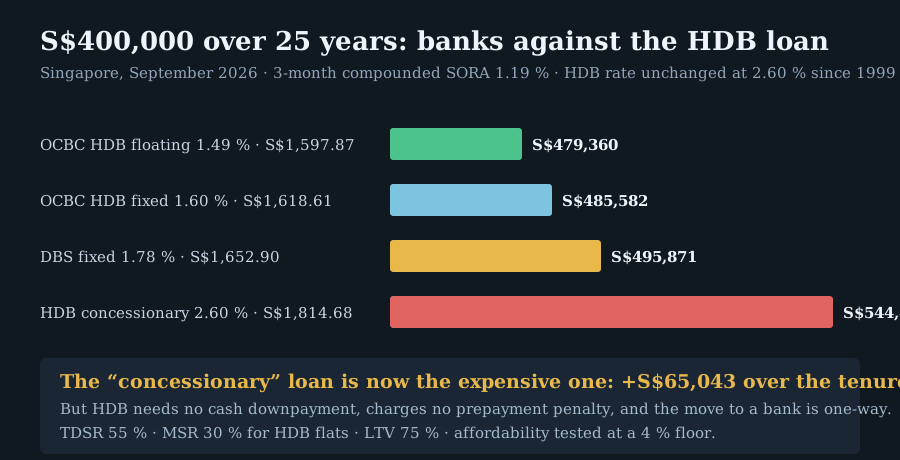
One significant advantage of bank loans over HDB's concessionary loan (currently 2.6%) is the substantially lower interest rates offered by commercial banks, often starting around 1.35-1.55%. This can lead to considerable savings over the loan tenure. Additionally, mortgage interest may qualify for tax relief up to S$8,000 per year, further reducing your overall financial burden. Banks also frequently offer attractive cashback or promotional benefits, sometimes up to S$3,300, to entice new customers. The flexibility to refinance after the lock-in period allows borrowers to adapt to changing market conditions and secure better rates.
Advantages
- Lower interest rates than HDB loan
- Potential tax relief on interest paid
- Cashback and promotional offers
- Flexibility to refinance for better terms
- Access to diverse financial products
Risks
- Rate hikes if SORA increases significantly
- Early repayment penalties during lock-in
- Risk of overborrowing (TDSR rejection)
- Stricter underwriting by foreign banks
- Refinancing hurdles during market instability
Despite the advantages, there are inherent risks. The primary risk is interest rate hikes. If SORA rises significantly, your monthly repayments for SORA-pegged loans will increase. It is advisable to stress-test your affordability at a higher interest rate, perhaps 3-4%, to ensure you can manage repayments. Penalties for early repayment within the lock-in period, typically 1.5% of the prepaid amount, can be costly. Overborrowing, particularly if you exceed TDSR limits, can lead to loan rejection, causing delays and potential loss of your option fee. Foreign banks, while flexible, may also impose stricter underwriting during periods of economic volatility, making approval more challenging.
Expert tips can help you navigate these complexities. Start shopping for mortgage packages 4-6 weeks before signing your Option-to-Purchase (OTP) to leverage promotional rates. Consider using a mortgage broker, as they often have access to bulk discounts and can simplify the comparison process. Always stress-test your loan affordability at a higher interest rate (e.g., 4%) to ensure long-term sustainability. If you anticipate rising interest rates, prioritizing a fixed-rate package for 2-3 years can provide stability. For HDB resale or BTO properties, local banks are generally the best choice, while expats should explore Standard Chartered and HSBC for their tailored offerings. Lastly, continuously track SORA via the ABS website and plan to refinance after your lock-in period if market conditions become more favorable.