
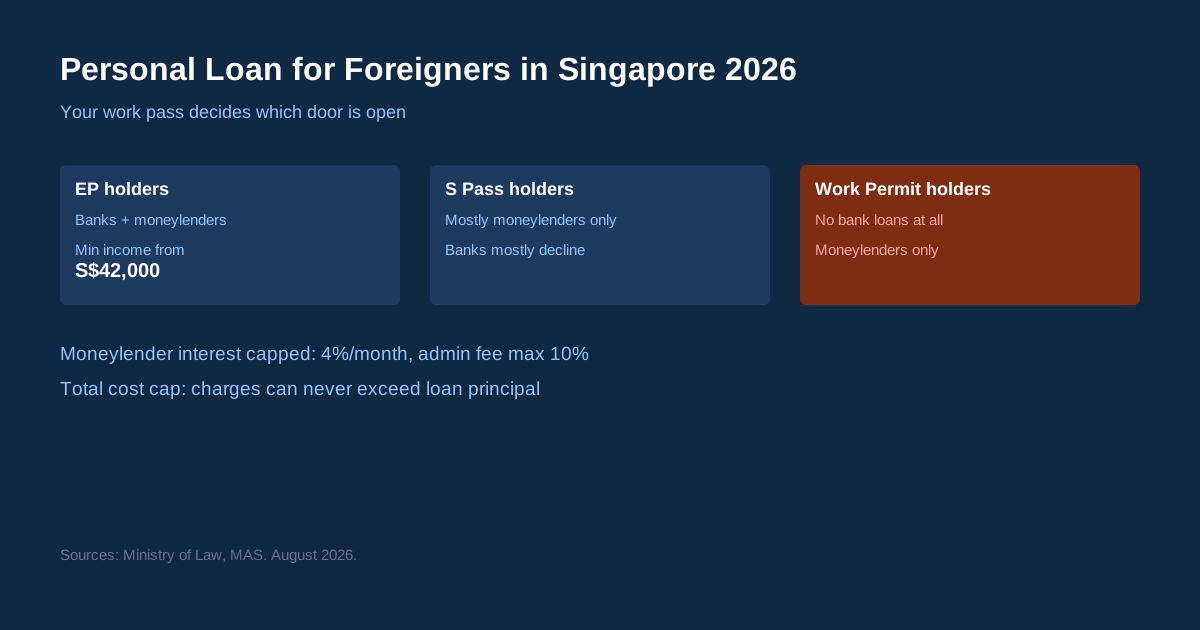
Your work pass type decides which door is even open to you: Employment Pass (EP) holders can apply for both bank loans and licensed moneylenders, S Pass holders are mostly shut out of major banks and must go to licensed moneylenders, and Work Permit holders cannot get an unsecured bank loan at all — only a licensed moneylender. Minimum annual income for banks ranges from S$42,000 (Citibank) to S$90,000 (Standard Chartered), while licensed moneylenders have no statutory income floor but cap your loan at exactly 6 times your monthly income if you earn S$20,000+ a year, or as little as S$500 if you earn under S$10,000.
Which loans you actually qualify for, by pass type
| Pass type | Bank loans | Licensed moneylenders |
|---|---|---|
| Employment Pass (EP) | Yes — widest access | Yes |
| S Pass | Mostly no — most major banks decline | Yes |
| Work Permit | No — banks don't offer unsecured loans | Yes |
If you're on a Work Permit or S Pass, don't waste time applying to retail banks — go straight to a MinLaw-licensed moneylender (verify on the official registry at rom.mlaw.gov.sg before signing anything).
Bank personal loans: minimum income by lender (EP holders)
| Bank | Min. annual income | Max borrowing multiple |
|---|---|---|
| CIMB | S$30,000 | 4x monthly salary / S$100,000 |
| Citibank (Quick Cash) | S$42,000 | up to 8x (income S$120k+) |
| OCBC (ExtraCash) | S$45,000 | 4x monthly salary / S$100,000 |
| DBS/POSB | S$60,000 | up to 10x (income S$120k+) |
| Trust Bank | S$60,000 | 4x monthly salary / S$100,000 |
| HSBC | S$65,000 (from 1 Oct 2025) | 4x monthly salary / S$100,000 |
| Standard Chartered (CashOne) | S$90,000 | 4x monthly salary / S$100,000 |
UOB personal loans are officially restricted to citizens and PRs — foreigners earning S$40,000+ can only access UOB Cashplus, an unsecured credit line, not the standard personal loan product. For incomes under S$120,000, MAS also caps your total unsecured debt across ALL banks combined at 12 times your monthly income — applying to five banks at once won't get you five times the credit.
Licensed moneylender caps: what the Ministry of Law actually allows
| Your annual income | Max aggregate borrowing (all lenders combined) |
|---|---|
| Under S$10,000 | S$500 |
| S$10,000 – S$19,999 | S$3,000 |
| S$20,000 and above | 6x your monthly income |
This cap is aggregate across every licensed moneylender in Singapore, not per lender — borrowing S$3,000 from one and trying for another S$3,000 from a second lender when your income tier caps you at S$3,000 total is not possible; MLCB (Moneylenders Credit Bureau) tracks this across the industry.
The legal price ceiling: what a licensed moneylender can charge, at most
- Interest: capped at 4% per month, regardless of your nationality, income, or residency status.
- Late interest: also capped at 4% per month, and only on the overdue amount — not the full outstanding balance.
- Admin fee: up to 10% of principal, deducted upfront from the cash you receive — never demanded as a separate payment before disbursement.
- Late fee: capped at S$60 per month overdue.
- Total cost cap: all charges combined (interest + late interest + late fees + admin fee) can never exceed the original loan principal. On a S$3,000 loan, worst case total repayment is S$6,000.
How to spot a loan shark impersonating a licensed lender
| Signal | Loan shark | Licensed moneylender |
|---|---|---|
| First contact | WhatsApp, Telegram, SMS, cold call | Own website / registered office only |
| Meeting | "100% online", no in-person step | Must sign at registered office in person |
| Upfront payment | Asks for "processing fee" or "deposit" before payout | Never — 10% admin fee comes out of the payout itself |
| Singpass | Asks for your login/password/OTP | Never asks for your credentials |
| Documents | Holds your passport/work pass as "collateral" | May copy documents, never keeps originals |
If in doubt, cross-check the lender's exact business name, licence number, and registered address against the official Ministry of Law list at rom.mlaw.gov.sg before signing anything. Encountered a scammer? Report to the police hotline 1800-255-0000 or the anti-loan shark hotline 1800-924-5664.
Two rules that change your repayment plan when your pass ends
Banks require at least 12 months of remaining pass validity to approve a loan; licensed moneylenders are more flexible (typically 3-6 months). But regardless of lender, if your work pass is cancelled or you lose your job, the entire outstanding balance becomes immediately due — and lenders cap your maximum loan tenure to match your remaining pass validity, which can push your monthly payment much higher than the original schedule assumed.
For a broader rate comparison across all applicant types, see our personal loan rates comparison Singapore guide.
Frequently Asked Questions
Can a Work Permit holder get a bank personal loan in Singapore?
No. Retail banks in Singapore do not offer unsecured personal loans to Work Permit holders. You would need to apply through a Ministry of Law-licensed moneylender instead.
What's the maximum interest a licensed moneylender can charge me?
4% per month on the principal, and 4% per month late interest on any overdue amount only — never on your full remaining balance. Total combined charges can never exceed your original loan amount.
Does borrowing from a moneylender affect my bank credit score?
Moneylender activity is logged in the Moneylenders Credit Bureau (MLCB), separate from the bank-centric Credit Bureau Singapore (CBS) — it does not directly feed into your CBS rating, though banks may still consider your overall debt exposure.
Sources: Ministry of Law (Registry of Moneylenders, Moneylenders Act), Monetary Authority of Singapore, official bank rate pages (DBS, OCBC, Citibank, HSBC, Standard Chartered, UOB, CIMB, Trust Bank). Data as of August 2026; income thresholds and rates are set by individual banks and subject to change.
Update August 2026: what changed in bank income floors
HSBC raised its minimum income requirement for its personal loan product to S$65,000 effective 1 October 2025, up from the previous S$60,000 floor — a reminder that these thresholds move roughly once a year and the number you saw on a comparison site six months ago may already be stale. Before applying, always confirm the current minimum income directly on the bank's own page rather than a third-party aggregator, since some portals still list outdated lower figures that no longer match the bank's actual underwriting criteria.
| What to verify before applying | Where |
|---|---|
| Current minimum income for your target bank | Bank's own official loan page |
| Moneylender licence validity | rom.mlaw.gov.sg official registry |
| Your remaining work pass validity | MOM work pass portal |
If your loan application gets rejected
A rejection from one bank doesn't mean you're locked out entirely — different banks set different income floors and weigh your remaining pass validity differently, so a rejection from Standard Chartered (S$90,000 floor) doesn't predict the outcome at CIMB (S$30,000 floor). If you're an EP holder who was declined everywhere, a licensed moneylender remains a legal fallback, just at a much higher capped interest rate (4%/month) than any bank would charge.